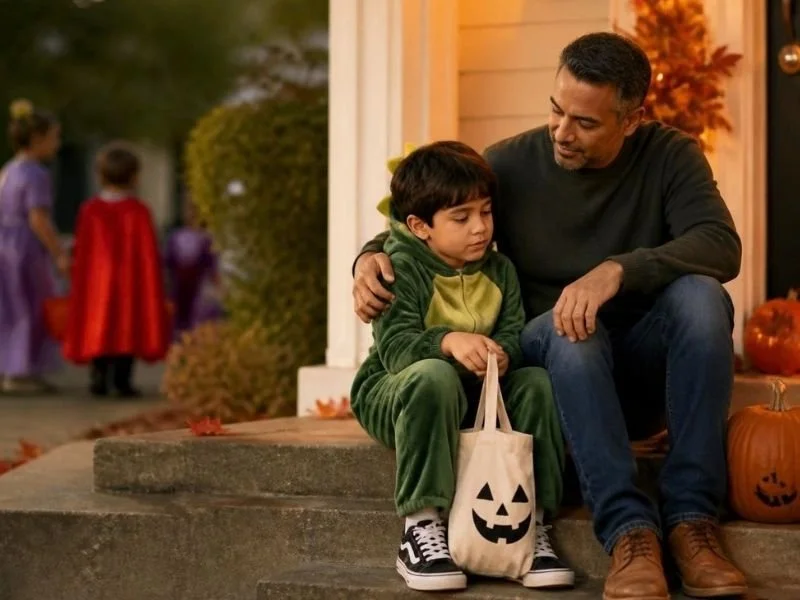
Halloween looks like pure fun on the outside. Costumes, candy, decorations, a party at school. For some kids, it is also scratchy fabric, a mask that blocks their view, a hallway of shrieking classmates, strobe lights at a neighbor's house, and a schedule that runs two hours past bedtime. Sensory overload in children does not always look like fear. Often it looks like a meltdown over something small at the exact moment everyone else is having a great time.
If last Halloween ended in tears, this year can go differently with some planning.
What Overstimulation Actually Looks Like
Kids rarely say "there is too much input right now." They show it instead:
Covering ears, squinting, or hiding their face
Suddenly needing to leave, or bolting without explanation
Refusing to put on or keep on a costume
Meltdowns over a detail that seems trivial
Going completely silent and still, which is easy to mistake for being fine
Physical complaints: stomachache, headache, feeling hot
Clinginess in a child who is usually independent
Escalating hyperactivity, silliness that tips into out of control
That freeze response is the one adults miss most. A quiet child at a loud party is not necessarily a comfortable child.
Why Halloween Hits Harder Than Other Holidays
Most holidays are predictable. Halloween is built on surprise. Someone jumps out. A decoration moves. A familiar neighbor is behind a mask. For a child who relies on knowing what comes next, the entire premise of the night is destabilizing.
Add the sensory pile-up. Costumes have tags, seams, face paint, and hoods. Parties bring noise that bounces off gym walls. Trick-or-treating happens in the dark, off-schedule, with sugar involved. Any one of these is manageable. Stacked together on a school night, they are a lot for a nervous system that is easily flooded.
Get Ahead of the Costume
The costume is the most controllable variable, and it causes more Halloween conflict than anything else.
Try it on at least a week out, and again a few days later, for longer each time
Cut out tags, and look for soft fabrics over stiff or scratchy ones
Let them wear a familiar shirt or leggings underneath
Skip masks. Face paint, hats, or a costume that reads clearly without one avoids the vision and breathing problems masks create
Consider a costume built on clothes they already like wearing
Have a backup: a hoodie version, or a simple accessory that still counts
If your child changes their mind on the day, let it go. A kid in a plain sweatshirt who is regulated is having a better Halloween than a kid in the perfect costume who is falling apart.
Make a Plan Your Child Knows About
Predictability does most of the heavy lifting here.
Walk or drive the trick-or-treating route in advance so it is familiar
Tell them the plan out loud: how many houses, roughly how long, and what happens after
Agree on an exit signal before you go, a word or a hand squeeze that means "I am done" with no negotiation
Pick a quiet base: the car, a porch, home if you are close
Bring noise-reducing headphones or earplugs if your child uses them
Go earlier, when it is less crowded and less dark
Skip the houses with fog machines, animatronics, and strobes, and say so plainly
Setting a smaller goal on purpose works well. Six houses that go well beats an ambitious route that ends in a meltdown.
Handle the School Party Separately
The classroom party is its own event, and you usually have less control over it. Ask the teacher what the plan is, whether there is a quieter task your child could help with, and whether stepping out for a few minutes is an option. Many teachers are glad to have a heads up and will build in an out.
Sending a familiar snack also helps, since food at parties is unpredictable and unfamiliar textures are one more thing to manage.
Protect What Happens After
The crash after a big night is real. Sugar, late bedtime, and hours of stimulation add up, and the fallout often shows on Saturday or the following Monday rather than Halloween night itself.
Get back to normal routines quickly, keep the next day low-key, and do not schedule anything demanding right after. If your child is dysregulated the following day, that is a normal recovery curve, not a behavior problem.
When Overwhelm Is Bigger Than One Holiday
Halloween is a stress test. If your child is regularly overwhelmed by noise, crowds, textures, and transitions, and it is affecting school, friendships, or family life year-round, it is worth looking closer. Sensory sensitivity often travels with anxiety, ADHD, or other differences in how a child processes the world, and each one responds to different support.
CBH's youth services include therapy and evaluation for kids and teens, in person and through telehealth across California.
A Smaller Halloween Still Counts
Nobody is grading your family's Halloween. Two houses and an early bedtime is a win if your child ends the night feeling good about it.
If the harder days are becoming the pattern rather than the exception, CBH is here to help. Book an appointment or find a location near you.